What work can robots do?
Summary
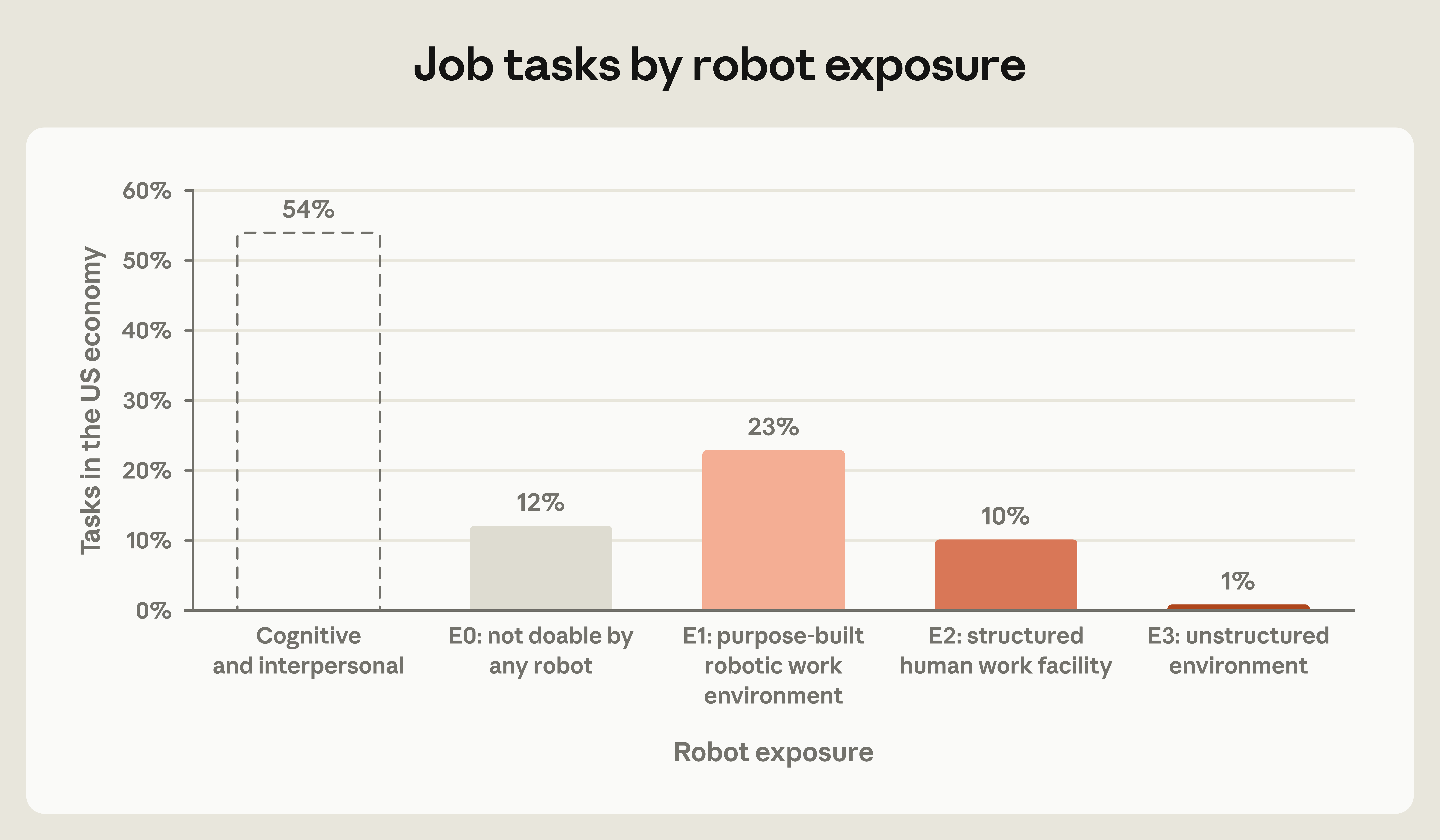
Legate-Yang and Massenkoff use model-assisted ratings of occupational tasks to estimate what robots can do and what deployment would cost. They estimate that robots can perform tasks accounting for 34% of US working time in at least some settings, but only about 0.3% of working time is exposed to robots estimated to be cost-competitive today.
Why it matters
The report makes the gap between technical capability and economic adoption concrete. Purpose-built environments, integration, supervision and other deployment costs can keep technically feasible automation from paying for itself.
What to keep in mind
These are task-exposure and cost estimates, not observed automation or job losses. Ratings, time weights and costs rely heavily on model judgments; demonstrations in arranged settings may not transfer to ordinary workplaces. Historical correlations and fixed-wage cost scenarios do not establish future employment effects.