The Productivity J-Curve: How Intangibles Complement General Purpose Technologies
· The journal supplies an issue month without a publication day; 15 January is used for sorting. The linked author-hosted working-paper revision is dated January 2020.
Summary
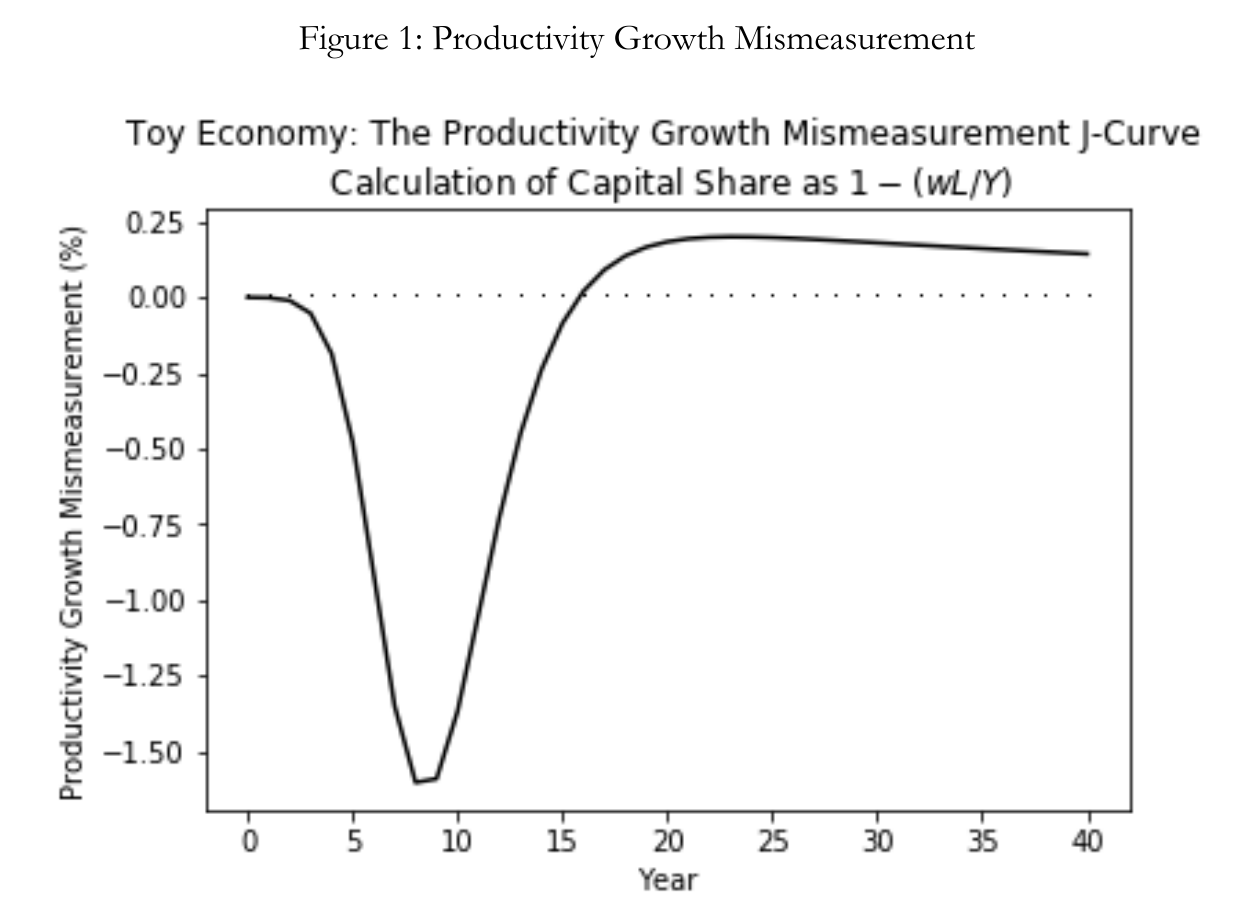
The authors model how unmeasured investment in workflows, skills and other intangible assets distorts productivity statistics. Early investment uses recorded inputs while creating unrecorded output; later, its unrecorded capital services help produce measured output. Historical computer and software estimates illustrate the resulting Productivity J-Curve.
Why it matters
The framework explains why adopting AI can require costly reorganization before returns appear, and why both the initial slowdown and later acceleration in measured productivity can be misleading.
What to keep in mind
This is a growth-accounting model with historical estimates, not proof that today's AI investment will produce a rebound. Results depend on assumptions about intangible investment, aggregation and market valuation. Complementary investment alone does not guarantee a J-curve.