Forecasting the Economic Effects of AI
· Revised 20 May 2026
Summary
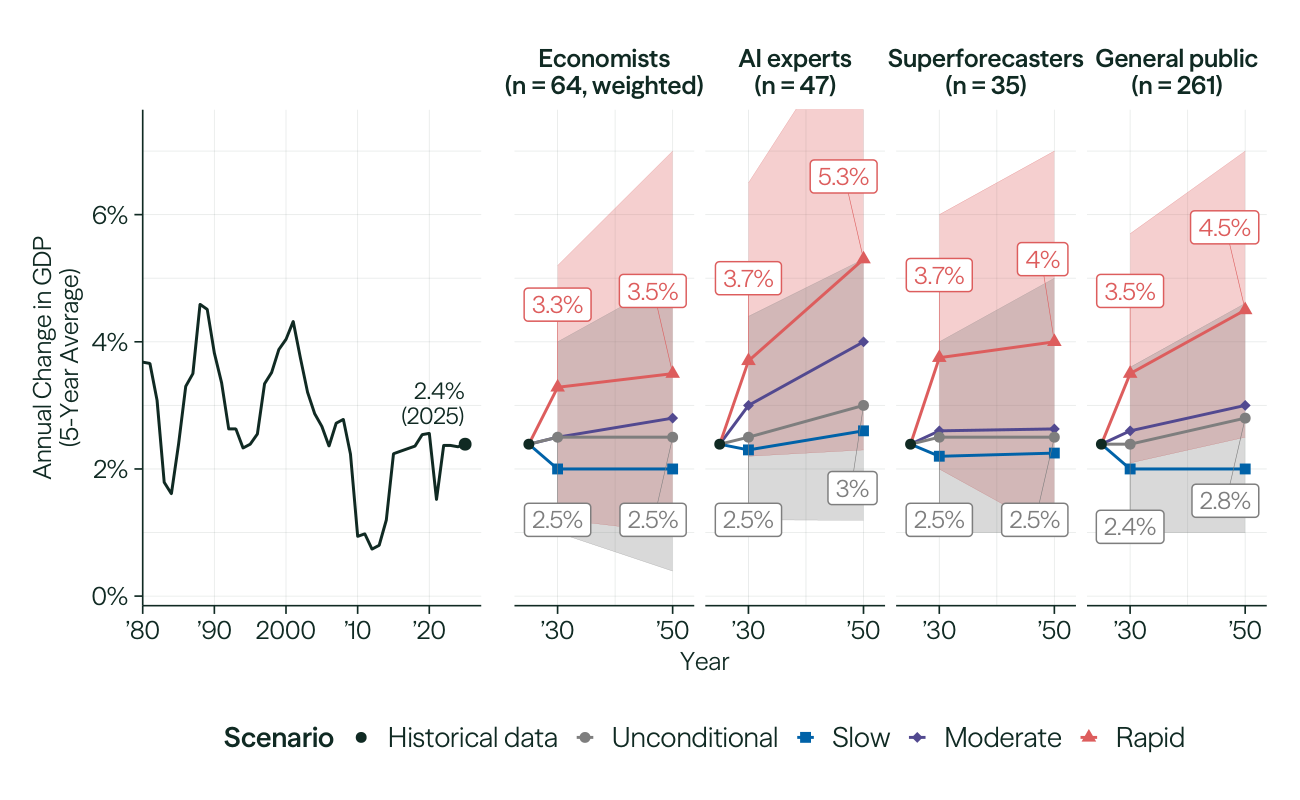
A structured survey compares forecasts from economists, AI-industry experts, AI-policy experts, superforecasters, and the public. Central group medians put annual GDP growth near 2.5%; under a rapid-automation scenario, forecasts rise to roughly 4% while labor-force participation falls from 62% to 55% by 2050 and wealth becomes more concentrated.
Why it matters
The report makes disagreement about AI's economic effects measurable instead of presenting one forecast. Matt Clancy's interpretation of related FRI work suggests that persistent gaps reflect different assumptions about generalization, diffusion, and bottlenecks rather than missing facts alone.
What to keep in mind
These are elicited beliefs, not observed outcomes. Expert selection, nonresponse, scenario framing, and different prior models of technological change can all shape the results; deliberation need not make those models converge.