How employment is changing at Anthropic
Summary
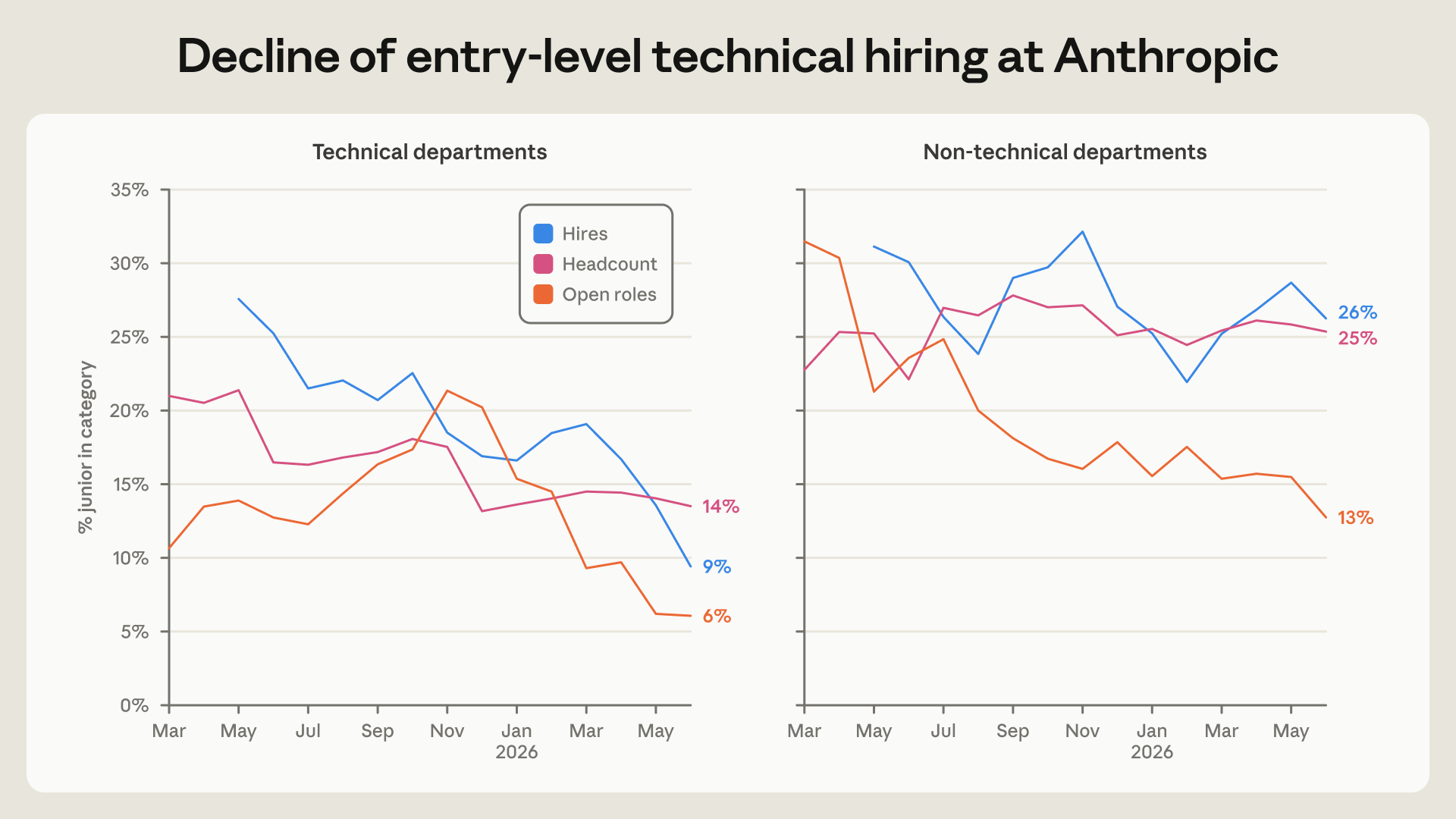
Internal records show junior roles falling from 27% to 9% of technical hires as Anthropic expands its use of agents. Output per employee rises in coding and several business functions, while work shifts toward agent supervision, judgment and coordination. Total technical hiring still grows; the report documents changes in hiring composition rather than an overall employment decline.
Why it matters
The case links task automation to actual hiring and organizational change inside an AI-intensive firm. More machine output can increase the value of scarce human attention and create new coordination work alongside pressure on entry-level roles.
What to keep in mind
This is a producer-affiliated observational study of one unusually fast-growing firm. Tool adoption is selected, autonomous adopters have pre-trends, and code volume and reverts only partly measure useful output and quality. Agent runtime is not human-equivalent labor. The study does not establish causal or economy-wide employment effects.