The Macroeconomic Effect of AI: Sizing the Software Engineering Channel
· Author-hosted paper version dated 14 September 2026; NBER Working Paper 35793 lists September 2026.
Summary
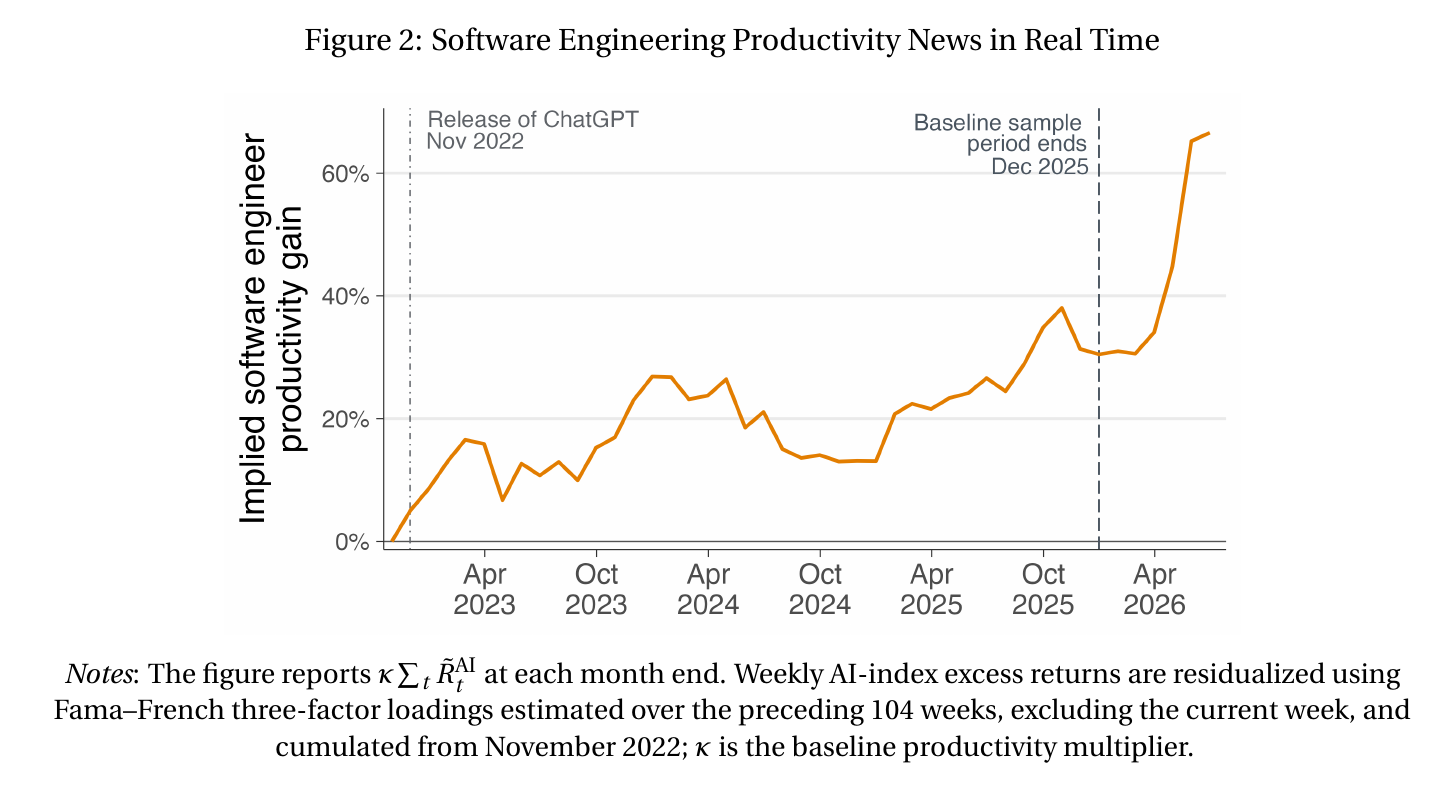
The authors relate firms' stock-market responses to an AI index to their software-engineering payroll shares, then interpret the relationship through a model. AI news from November 2022 to December 2025 implies expected productivity gains equivalent to a permanent 32.6% increase in software engineering. This measures market expectations, including future gains.
Why it matters
Asset prices offer a forward-looking counterpart to task experiments and national accounts. The approach connects expected firm benefits to economy-wide output while making the assumptions needed for that translation explicit.
What to keep in mind
This is an empirical relationship interpreted through a structural model, not measured productivity or realized GDP growth. Results depend on market beliefs, calibrated substitution, selected public firms, imputed payroll and separating productivity news from demand and discount-rate changes. Markets can be wrong.